Fleet Electrification in Saudi Arabia: Are Companies Ready?

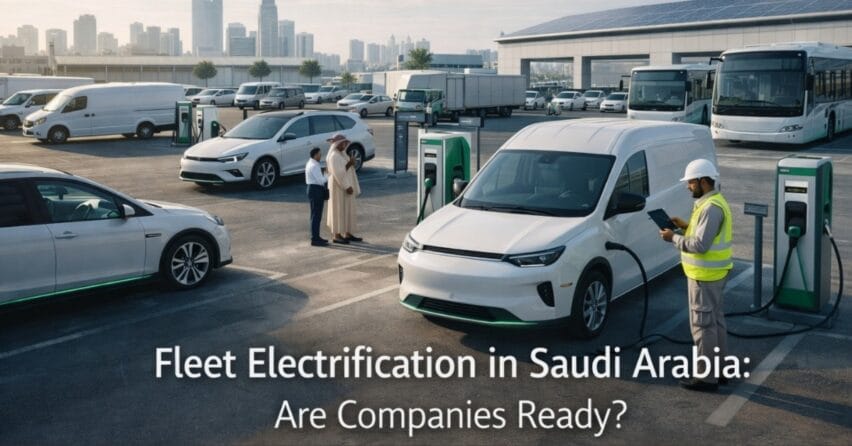
Commercial fleets are critically important in Saudi Arabia, powering the economy and logistics and Vision 2030 megaprojects. As of today, Saudi companies have deployed over 500,000 commercial vehicles daily, including delivery vans, airport shuttles, rental fleets circling, and logistics trucks moving cargo and all kinds of goods coast-to-coast. Vision 2030 aims to have 30% of Riyadh's vehicles be electric by 2030, making them more sustainable and boosting the country's adoption of greener vehicles.
KEY TAKEAWAYS
How many Saudi companies have started fleet electrification?
Major operators, like Budget Saudi, Hertz, and SAPTCO, have pilot programs with hundreds of EVs.What's the biggest challenge for fleet electrification?
Charging infrastructure costs and limited vehicle availability for commercial applications like delivery vans.It is a notable goal, providing opportunities but also posing some challenges. To achieve this, several things matter, like government contracts, along with corporate ESG and airport tenders, all of which need to focus on adopting EVs. Charging infrastructure still lags behind that of private cars, the capacity for Electric Car maintenance in the Saudi Arabia is limited, and low fuel prices continue to be a significant obstacle. Fleet operators must decide whether to electrify their fleets now to secure a competitive advantage or to adapt as regulations tighten and the number of chargers increases. Their decisions today determine Saudi Arabia's commercial mobility tomorrow.
High Cost
Fleet electrification is a highly futuristic initiative that could come with several longer-term benefits to the country. It is well-known that electric vehicles (EVs) have lower running costs, and their maintenance is both less frequent and less expensive than that of conventional cars. However, the primary challenge is the upfront investment, as electric vehicles are pricier and require a significant financial commitment.
A fleet operator replacing 100 sedans faces these numbers:
Fleet Cost Comparison: 100 Vehicles (5-Year Ownership)
|
Cost Category |
Petrol Fleet (100 Toyota Camrys) |
Electric Fleet (100 Tesla Model 3s) |
Difference |
|
Purchase Price |
SAR 11 |
SAR 18 |
+SAR 7 |
|
Fuel/Electricity |
SAR 7.5 |
SAR 3 |
- SAR 4.5 |
|
Maintenance |
SAR 2 |
SAR 750,000 |
- SAR 1.25 |
|
Charging Infrastructure |
SAR 0 |
SAR 2 |
+SAR 2 |
|
TOTAL 5-YEAR COST |
SAR 20.5 |
SAR 23.75 |
+SAR 3.25 |
Prices in millions
The table shows that EVs cost 16% more in upfront costs but save on fuel/maintenance; however, the break-even is nearly 7 years with infrastructure costs included. This approach may be suitable for companies that keep vehicles for over 10 years, but it may not be practical for rental fleets that cycle through vehicles every 2–3 years.
Charging Infrastructure Gaps
Boosting EV penetration and running them successfully needs a robust and highly reliable charging network across Saudi Arabia. Budget Saudi operates across multiple cities with dozens of rental locations, and electrifying their fleet effectively requires installing charging stations at every location. This is a huge investment before even a single vehicle starts to ply on the road, actually.
There is a similar situation for corporate fleets too; a company with 500 vehicles needs workplace charging. Installing 200+ charging points requires electrical upgrades costing SAR 3-5 million; before that, building approvals and necessary permit approvals take months.
This scenario is even more challenging for logistics companies, because delivery vans that make 50 stops a day may need 15–20 minutes of fast charging. Those stations cost SAR 500,000-800,000 each, which is a huge cost burden.
The public charging network helps, but this is a work in progress and not sufficient presently. EVIQ's 600-plus stations target private vehicles, not commercial fleets needing dedicated infrastructure.
Challenge Vehicle Availability
Operating a fully electric sedan is relatively simple, and many options are available from brands like Tesla, BYD, and Polestar. But fleets need diversity to make them more effective.
What's Available:
- Passenger sedans (Tesla, BYD, Polestar)
- Small crossovers (Tesla Model Y, BYD Atto 3)
- Electric buses (BYD, Yutong)
What's Missing:
- Delivery vans (Mercedes eSprinter limited)
- Pickup trucks (F-150 Lightning not sold in KSA)
- Heavy trucks (electric 18-wheelers unavailable)
- Refrigerated transport vehicles
Logistics companies want electric delivery vans. But there aren't 500 units available in Saudi Arabia even if they wanted to buy them today.
Range Anxiety for Commercial Use
Range anxiety is not just a personal-vehicle issue; it is even more serious for commercial vehicles. Unlike personal cars, fleet vehicles cannot be charged at home overnight with the Home EV Charging Stations. A delivery van needs to complete its route regardless of battery level. A taxi is unable to make passengers wait while it charges.
SAPTCO's electric buses face these constraints more severely. Intercity routes between Riyadh and Jeddah cover 950 km, and current electric buses manage a 300–400 km range. This means mid-route charging is necessary, as are stops, which add extra travel time.
However, EV city buses are a good option, as the model works better. Routes are mostly shorter and allow overnight charging at depots. That is the reason SAPTCO's 200+ electric buses operate primarily in Riyadh and Jeddah city services, not intercity routes.
Fleet Electrification Progress in Saudi Arabia (2025)
|
Company |
Fleet Size |
EVs Deployed |
Target |
Key Challenge |
|
Budget Saudi |
47,000+ vehicles |
500+ EVs |
20% by 2027 |
Charging at rental locations |
|
SAPTCO (Buses) |
3,000+ buses |
200+ electric |
30% by 2030 |
Range for intercity routes |
|
Careem/Uber Fleet |
50,000+ drivers |
Minimal |
Growing slowly |
Driver resistance, cost |
|
Corporate Fleets |
100,000+ vehicles |
<1% electric |
Varies |
No central charging |
|
Logistics Companies |
150,000+ trucks |
Pilot programs |
Uncertain |
Heavy-duty EV unavailable |
What Companies Are Actually Doing
Despite the challenges and key constraints, there is some encouraging progress. Budget Saudi is one example with the most aggressive fleet electrification. To date they have about 500+ EVs and plan 20% fleet electrification by 2027. To address the infrastructure challenge, they are installing charging at rental locations and marketing EVs to environmentally conscious customers.
But even after doing so, the Budget acknowledges challenges; for example, not all customers want EVs. Range anxiety is a real issue with most of them, and charging stations are still not enough. There has been major commitment and investment towards electrification, but overall the approach stays cautious due to several challenges.
SAPTCO is another big player, which has 200+ electric buses, proving that the technology works for city routes. But refrained from committing to 100% electrification primarily until battery technology improves for intercity service. This is a longer-term approach and could be successful once the bottlenecks are addressed.
Corporate fleets seem to be the slowest to adopt, with reasons fairly well-known. Today, most companies are in the pilot phase, not committing more than 10–50 vehicles to testing feasibility. This is to suggest that they wish to study and observe the market before making a big move. This will reveal how early adopters manage costs and operational challenges before taking a clear approach to their operations.
Government Incentives Help But Aren't Enough
In the entire transition towards fleet modernisation and greener vehicles, the role of government is critical. There have been some active measures to support fleet electrification through initiatives like lower import duties, free temporary public charging, and optimising licensing. These are key steps and are quite helpful, but they certainly are not enough to bridge the massive infrastructure costs or lower vehicle availability. There are some concrete steps required.
What needs to happen for faster adoption:
- Government subsidies for fleet charging infrastructure
- Bulk purchase programs reducing per-vehicle costs
- Mandated EV quotas for government contractors
- Tax incentives for companies electrifying fleets
- Faster permitting for charging installations
The Transition Timeline
Keeping in mind all the challenges, investment and time it is going to take, realistically, significant fleet electrification in Saudi Arabia will take until 2030-2035. Today, to achieve this goal, there are many initiatives running at different stages, as companies are trying various aspects, planning infrastructure investments, and waiting for better vehicle availability.
The transition is most likely to occur in phases:
- 2025-2027: Pilot programs and infrastructure planning
- 2027-2030: In the first phase, nearly 10–20% fleet adoption along with major infrastructure build initiation
- 2030-2035: Expected to reach 30-50% conversion due to technology maturing
- Post-2035: ultimate goal of majority-electric fleets becoming standard
Conclusion
In a broader sense, it appears that Saudi companies are making efforts to move towards fleet electrification, but they face several key challenges that are holding them back. These challenges include high costs, inadequate charging infrastructure, limited availability of commercial vehicles, and range limitations. Major players involved in this initiative by working out and planning in planning phases rather than going in one big step as they wait for technology to improve and mature before committing to large-scale electrification.
Dinesh Goluguri

With over 15 years of experience in the automotive world, Dinesh Goluguri bringing hands-on experience and deep market knowledge. Passionate about SUVs, sports cars and luxury vehicles, he combines enthusiasm with expertise in delivering insights that resonate with car buyers and enthusiasts alike. With a special interest in car modifications and upgrades, Dinesh offers a unique perspective that goes beyond standard reviews, highlighting both factory features and customization potential. His work helps readers navigate new launches, features and trends in the dynamic automotive market.
Read Full Bio-
Volvo EX40 -
Volvo XC60 -
Volvo XC90 -
Volvo XC70 -
Volvo S90 -
Volvo EX60 -
Volvo EX90 -
Volvo EX30 -
Volvo ES90 -
Volvo EC40
- News


- Latest
- Popular
-
 Volvo XC70Price coming soon
 -
 Volvo EX90Price coming soon
 -
 Volvo ES90Price coming soon
 -
 Volvo EX30SAR 129,900
 -
 Volvo S90Price coming soon
 -
 Volvo EX60Price coming soon
-
 Volvo EX40SAR 244,750 - 277,750
 -
 Volvo XC60SAR 260,000
 -
 Volvo XC90SAR 360,750
 -
Volvo XC70Price coming soon
-
Volvo S90Price coming soon
-
Volvo EX60Price coming soon

-
 Volvo XC9016 May, 2026 .
 -
 Volvo XC6016 May, 2026 .
 -
 Volvo EX4016 May, 2026 .
 -
 Volvo EC4016 May, 2026 .
 -
 Engineered to go further23 Jan, 2026 .