Public Transport Expansion vs Private Cars: What's Changing in KSA Cities

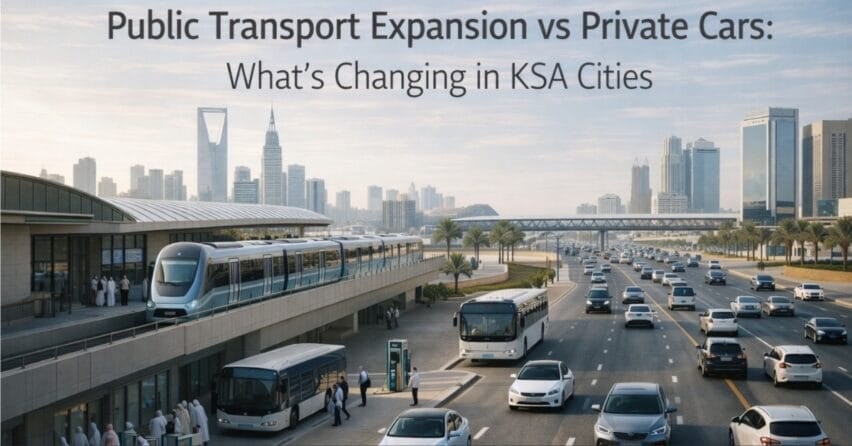
As Saudi Arabia made key strategic decisions by accelerating investments in metros, buses, and shared mobility, with a clear objective to maintain a balance between public transport growth and personal mobility choices. This has started to show a major shift in all the key cities in the country. Riyadh's streets transformed overnight in December 2024 when the $22.5 billion metro launched; it consists of six fully automated lines covering 176 km that became a choice of mobility for 1.9 million passengers in its first week alone. By early 2025, ridership had crossed a massive 120 million, which had set free the roads from cars along the way, chipping away at a car-dependent culture where 90% of trips once meant private vehicles clogging six-lane highways.
KEY TAKEAWAYS
How extensive is Riyadh's new metro system?
Six lines, 176 km, 85 stations, and capacity for 3.6 million daily passengers when fully operational.Are people actually using public transport in Saudi cities?
Yes, 23 million bus passengers in Q1 2025 across 15 cities, up 34% from Q4 2024.Other KSA cities are also following similar footsteps, with the Jeddah metro breaking ground in 2026. Riyadh's buses electrify while Dammam builds BRT corridors. Vision 2030 has a stated goal of lowering car numbers, cleaner air, and congestion-free roads, with Saudi Arabia's new EV Policy contributing to that. So, what does the future look like? Will Saudis move from SUVs to trains? The numbers suggest change is coming, and perhaps both will coexist in playing vital roles.
The Metro Reality
It is worthy of note that Riyadh Metro is considered the world's longest fully driverless network. As expected, there is a train every few minutes even during peak hours, and stations are nicely done with shops, restaurants, parking, and wifi. Furthermore, a strong integration with buses allows seamless transfers using one ticket, thus becoming a highly convenient and faster mobility option.
But that alone would not be sufficient or enough, and this is what matters for car buyers. Riyadh has 8 million residents, and the metro carried 120 million trips by early 2025, roughly 15 trips per resident over three months. That comes out to weekly use, not daily commuting for most people.
Despite the metro, a large number of Riyadh residents still drive. As the metro serves specific corridors: Olaya Street business district, King Abdulaziz Road, and airport connections. Much of Riyadh remains car-dependent because the city spreads over hundreds of square kilometres.
Who Benefits Most
The metro works for:
- Daily commuters to central districts
- Airport travelers avoiding parking fees
- Students at universities near stations
- Visitors unfamiliar with Riyadh
- Peak-hour traffic avoiders
The metro doesn't work for:
- Families needing car seats
- Heavy grocery shopping
- Areas far from stations
- Flexible timing needs
- Door-to-door business travel
This creates a divided market. Young professionals in downtown can consider car-free living. Families in outer suburbs still need vehicles for school runs, weekend trips, and daily errands.
Public Transport Growth Across KSA (2024-2025)
|
City |
Metro |
Bus Riders Q1 2025 |
Infrastructure |
Car Impact |
|
Riyadh |
Operational |
15 million |
6 metro lines, 80 bus routes |
Growing |
|
Makkah |
None |
4 million |
Buses only |
Limited |
|
Madinah |
None |
1.3 million |
Buses only |
Minimal |
|
Jeddah |
Planned |
1.1 million |
Buses only |
Future |
|
Dammam |
None |
748,000 |
Buses only |
Minimal |
The Bus Network
Buses are one big element of public transportation, and ridership jumped a strong 34% from Q4 2024 to Q1 2025 across Saudi cities. Total Q1 ridership reached 23 million passengers across 15 cities, with Riyadh alone contributing 15 million, close to 5 million monthly trips.
If compared to cars, if 90% of trips happen by car and residents average two daily trips, that's 480 million car trips monthly versus 5 million bus trips. This clearly underscores the volume, and it is loud and clear that the growing public transport is a great sign, but in the overall mobility scheme of things, it remains a small share in comparison to the cars influenced by the growing EV Adoption and Growing Sales in Saudi Arabia.
The network includes:
- 80 regular routes in Riyadh
- Bus Rapid Transit lanes with priority
- 2,860 bus stops citywide
- Metro integration for transfers
- 25 park and ride facilities
This certainly hopes to improve mobility options for a vast number of people, but that alone is not enough or a substitute for cars. It is often observed that buses face the same traffic except on BRT lanes. Wait times average 10-15 minutes, and coverage gaps exist in many neighbourhoods across cities.
What This Means for Car Buyers
With growing public transportation, new car buyers are faced with considerations, though not entirely different from what drove their decision towards personal mobility. Anyone who lives near a metro station and works near another station can actually get an alternative to a car. They might consider whether a car is necessary for every single day. You might manage with ride-hailing for occasional trips plus the metro for commutes.
But if you are not among those who have access to public transportation easily, then a car becomes essential. Also, the metro is not available to reach every area, and buses don’t operate 24x7. Many families need a personal vehicle for various needs, almost doing multiple trips daily that are not possible or feasible by public transport.
However, car type matters more now. If using the metro for daily commutes, you might not need a large SUV. A smaller, efficient vehicle for weekend family trips makes sense. That shifts demand toward compact SUVs and crossovers.
The Long-Term Scenario
The government is focused on expanding public transportation to further strengthen cities by offering alternatives for personal mobility. Riyadh city has a plan to start Line 7, which connects Diriyah Gate, King Salman Park, and Qiddiya. That's another 65 km adding to the existing 176 km of metro network. Similarly, Jeddah will eventually get its own metro, and other cities are studying feasibility.
But these projects take years to become operational; Line 7 starts in 2026 with completion likely in 2030-2032. Jeddah's metro is in planning with no confirmed start date. Saudi cities remain car-dependent throughout the 2020s.
Unlikely European Model
There is a belief among certain sections of Saudi society that the Kingdom might follow the example of Europe, where extensive transit networks reduce car ownership. But looking at our geography and weather uniqueness, this may not occur in Saudi Arabia.
The climate makes walking and waiting uncomfortable 6-8 months yearly as temperatures exceed 40°C regularly. Nobody walks 10 minutes to bus stops in July heat.
Also, we have cities planned and developed mostly for cars with services like electric charging stations, parking facilities, and most cities are spread horizontally rather than concentrating density near transit. Retrofitting takes decades.
The cultural is another big aspect, where most people's preferences favour privacy and convenience. Saudi families like driving together over public transport with strangers.
Economics matter too; petrol is extremely cheap as compared to many global automotive markets. Unlike countries like Singapore or Hong Kong, where governments deliberately restrict car ownership, it is not financially prohibitive in Saudi Arabia. That matters, as people like personal vehicles that offer more freedom, convenience, safety and huge advantages than public transportation.
Conclusion
So it is quite visible that the government has been quite focused on expanding public transport; this is happening in real time in Saudi Arabia. Be it metros or buses, they are expanding across cities, but cars remain essential for obvious reasons. Metro serves specific corridors while leaving much of the city car-dependent. Taking this into account, car buyers should consider transit proximity when choosing vehicles but shouldn't expect European-style car-free living in Saudi cities anytime soon.
Dinesh Goluguri

With over 15 years of experience in the automotive world, Dinesh Goluguri bringing hands-on experience and deep market knowledge. Passionate about SUVs, sports cars and luxury vehicles, he combines enthusiasm with expertise in delivering insights that resonate with car buyers and enthusiasts alike. With a special interest in car modifications and upgrades, Dinesh offers a unique perspective that goes beyond standard reviews, highlighting both factory features and customization potential. His work helps readers navigate new launches, features and trends in the dynamic automotive market.
Read Full Bio-
Toyota Raize -
Toyota Fortuner -
Toyota Yaris -
Toyota Land Cruiser 70 Hard Top -
Toyota Urban Cruiser -
Toyota Camry -
Toyota Corolla -
Toyota Innova -
Toyota Veloz -
Toyota Highlander -
Toyota Liteace -
Toyota Hiace
- News
- Latest
- Popular
-
 Toyota CenturyPrice coming soon
 -
 Toyota TundraPrice coming soon
 -
 Toyota SequoiaPrice coming soon
 -
 Toyota bZ4XPrice coming soon
 -
 Toyota GR YarisPrice coming soon
 -
 Toyota Urban Cruiser 2026Price coming soon
-
 Toyota RaizeSAR 68,827 - 75,497
 -
 Toyota FortunerSAR 128,742 - 187,047
 -
 Toyota YarisSAR 66,700 - 78,832
 -
 Toyota Land Cruiser 70 Hard TopSAR 158,240 - 201,192
 -
 Toyota Urban CruiserSAR 82,915 - 92,115
 -
 Toyota CamrySAR 109,825 - 153,985

-
 Designed for the City06 May, 2026 .
 -
 Toyota Yaris06 May, 2026 .
 -
 It shines with a completely new style06 May, 2026 .
 -
 Toyota Crown06 May, 2026 .
 -
 the most amazing of its generation06 May, 2026 .
 -
 Toyota Corolla Cross06 May, 2026 .
 -
 Toyota Rav406 May, 2026 .
 -
 2026 Toyota Supra Track Edition06 May, 2026 .